Today I want to revisit something I first discussed back in 2015: that strange, overwhelming chaos an Empath can feel, emotionally and even physically, when faced with inauthentic energy.
Let me start with a question.
Have you ever spent time with someone who, on the surface, seems perfectly pleasant, kind, polite, even charming, but something in you tightens? You feel off, uneasy, maybe even a bit scrambled, like your thoughts won’t line up properly?
If that rings a bell, there’s a reason.
For an Empath, it’s rarely about what’s being said. It’s about what’s being felt underneath. You’re picking up on a mismatch, the subtle but unmistakable gap between who someone is presenting themselves to be and what’s actually going on beneath the surface. It’s like your internal radar is quietly sounding the alarm: something here isn’t real.
Now, if you’re not only empathic but also have autistic traits, that experience can feel even more intense and disorienting. Why? Because there’s often a deep reliance on consistency and clarity. When someone’s words, tone, body language, and underlying emotional state don’t line up, it creates a kind of internal static. You’re not just sensing the inauthenticity, you’re trying to process it, make sense of it, and your system can’t quite reconcile the contradiction.
That’s where the shutdown can come in.
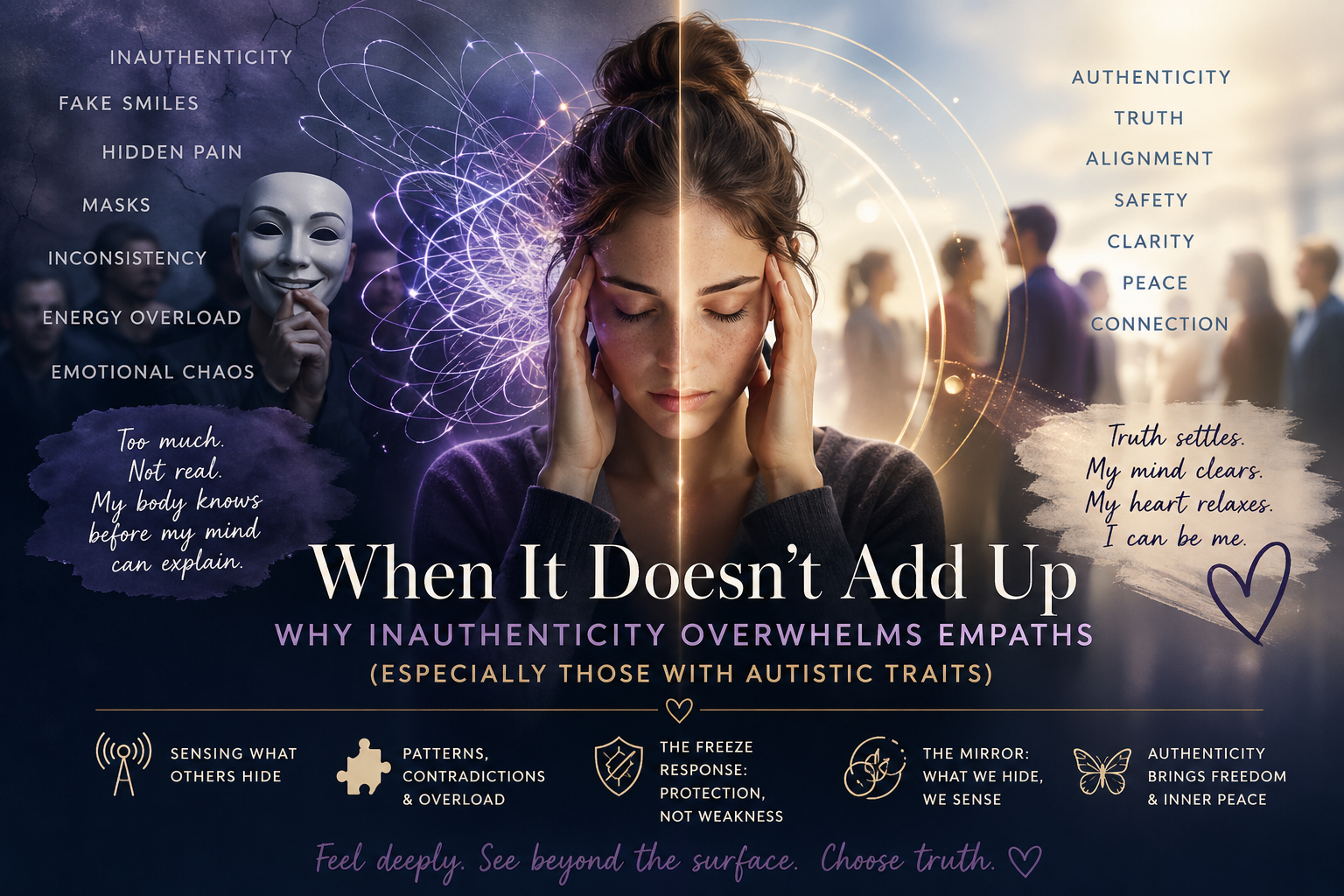
For many Empaths, encountering inauthenticity triggers a kind of protective freeze response. Words get stuck. Thoughts scatter. Memory feels unreliable. It’s not weakness, it’s overload. Your system is trying to filter conflicting signals while also protecting you from whatever emotional undercurrent you’ve picked up.
For someone with autistic traits, this can feel even more pronounced. The brain is already working hard to process social interaction in a structured way, and suddenly it’s faced with something that doesn’t follow any clear pattern. The result? A kind of internal short-circuit. You may find yourself defaulting to asking questions, going quiet, or feeling like you’ve temporarily “lost access” to your usual way of communicating.
I remember, back in my days as a hairdresser, there were clients who seemed absolutely lovely. Warm, friendly, easy to talk to. And yet, working with them, I’d feel awful, heavy, unsettled, almost ill at ease in my own skin. At the time, I couldn’t understand it. It didn’t make logical sense.
Later, when I understood my empathic nature, it clicked. I wasn’t reacting to what they were showing, I was feeling what they were hiding. Pain, insecurity, resentment, sadness… all wrapped up in polite conversation and a well-practised smile.
And that’s the thing: inauthenticity comes in many forms, and not all of it is malicious. Sometimes it’s just survival.
Here are a few examples that might trigger that “freeze mode” feeling:
- Someone who desperately wants to be liked, so they become overly agreeable or perform kindness rather than genuinely feeling it
- Someone carrying deep anger or resentment but presenting as calm and composed
- Someone shaped by a difficult childhood, masking insecurity with bravado or emotional distance
- Someone who has built an entirely new persona to hide parts of themselves they believe won’t be accepted
- Excessive or insincere praise that feels hollow rather than warm
- Stories that feel exaggerated or fabricated to gain attention or approval
And your reactions might look like this:
- Avoiding them, even though they’ve done nothing “wrong” on the surface
- Struggling to speak, words don’t come, or what you say feels disjointed
- A heavy, uneasy feeling in your stomach that lingers until you leave
- Feeling drained, foggy, or even physically unwell after spending time with them
- A confusing mix of liking the person but disliking how you feel around them
- A sense of helplessness, like you can’t quite “find your footing” in their presence
Here’s where it gets a bit deeper.
Just because you can sense inauthenticity in others doesn’t mean you’re completely free of it yourself. That’s not a criticism, it’s human.
Sometimes the discomfort you feel isn’t just about them. It’s also about recognition. You may be picking up on something in them that mirrors something you’ve had to suppress in yourself.
That’s not always easy to sit with.
Because the truth is, most of us have, at some point, learned to hide parts of who we are. We’ve smiled when we felt low. Pretended to enjoy things we didn’t. Softened our edges to be accepted. Played roles to get through situations.
In small doses, that’s part of life. But when it becomes a way of being, when the mask becomes the default, it creates a disconnect. And Sensitve people feel that disconnect sharply, both in others and within themselves.
This is especially true if you’re both empathic and wired to notice patterns and inconsistencies. You’re not just feeling the emotional layer, you’re detecting the structural misalignment. And your system doesn’t like unresolved contradictions. It wants coherence, truth, something solid to stand on.
When that’s missing, it can feel like trying to walk on shifting ground.
This is why authenticity matters so much for Sensitve people. Not in a performative “say whatever you want” sense, but in a grounded, honest alignment between inner and outer worlds.
Because when we bury parts of ourselves, especially traits we’ve judged as unacceptable, they don’t disappear. They go underground. And from there, they influence our thoughts, reactions, and relationships in ways we don’t always understand.
Commonly buried traits include:
- Anger
- Jealousy
- Fear of rejection
- Resentment
These don’t come out of nowhere. They’re often rooted in very human experiences:
- Being hurt or treated unfairly
- Growing up around anger and absorbing it
- Feeling overlooked or compared to others
- Experiencing rejection, especially in the early years
What starts as a small emotional response can, over time, build into something deeper, something we feel we have to hide to be accepted.
But hiding comes at a cost.
Because when you’re disconnected from parts of yourself, you’re also more Sensitve to that same disconnection in others. It becomes louder, more jarring, harder to tolerate.
That’s why doing your own inner work matters. Not to become perfect, but to become whole.
AN EMPATH’S GUIDE TO LIVING IN THE WORLD
Some traits may never fully disappear, and that’s okay. Some are deeply wired. But when you acknowledge them, understand them, and stop fighting their existence, they lose their intensity. They stop controlling you from the shadows.
And something shifts.
You feel more grounded. More clear. Less reactive. And interestingly, less thrown by inauthenticity in others, because there’s less inside you that it can hook into.
Being real with yourself is freeing in a way that’s hard to describe until you experience it. There’s a quiet steadiness that comes with it.
So if you find yourself freezing, scrambling, or shutting down around certain people, don’t dismiss it, but don’t fear it either. There’s information in that response. Sometimes it’s about them. Sometimes it’s about you. Often, it’s a bit of both.
Either way, it’s pointing you somewhere worth exploring.
Hope this gives you something to think about on your journey.
Until next time.
Diane
©DianeKathrine
 Empaths Empowered
Diane! Spot on. I’ve found holding up the mirror has really helped me when I’ve felt triggered.
And, interestingly, I’ve been having/reading conversations/books about authenticity.
I can always feel the inauthenticity in humans. And yes, in myself. And i really hate being inauthentic. And there are times when I just have to shut up and be polite. (my aging Mum)
I can be around inauthentic folks for a tiny while but tend to avoid. It often feels like toxic and unhealed energy within the humans.
Anyway, thank you so much!
Love and blessings, Elizabeth
Wallowing in Gratitude and Joy,
Elizabeth Sadhu, she/her/we/they/them
#NEUROSPICY #SPIRITTRANSLATOR
mobile: 541-914-3420
https://elizabethsadhufarwell.wordpress.com
Collective Liberation is my spiritual path.
#buildingthewe
#loveepidemic
Land Acknowledgement: Kalapuya Tribes
Sent from Proton Mail for Android.
You are most welcome, and thanks for sharing