What is Really Making You Angry as an Empath?

Have you found yourself suffering more with angry emotional reactions lately than what is usual? Have you ever wondered why?

Following on from my last post about the shadow side, today I want to discuss another way in which the shadow may be experienced: through anger.

The reason this is an important issue to address is because anger is especially damaging to the body. Anger stresses the adrenals, causes stomach problems, and weakens the heart area. in fact, just one minute of anger can suppress the immune system for five hours.

In current times it seems anger is being purposely stimulated amongst the masses, which is not good for the Empaths.

All around the world we see people getting angry or hateful over ‘local or global affairs.’ There is so much fury being projected on to issues presented online that it makes you question: are people really so angry with these issues or is it something else? Something deeper that has been suppressed that is trying to draw their attention?

An Empath will always be affected by the anger in others; but they also have their own to deal with. However, because they know the damage anger can do, when projected on to others, it is often suppressed. Which rarely leads to anything good.

You’re Never Angry About What You Think You’re Angry About!

The above statement is so true. We are rarely infuriated by what we think. We are simply projecting our pain when triggered.

When we project our pain on to external factors, instead of looking inwards to find and fix what needs fixing, we don’t uncover the real roots of our anger.

How Do We Uncover What is Really Making Us Angry?

An unhealed Empath, who has spent years stuffing down emotions, can find offence in pretty much everything. In these times, however, everything is rising to the surface. As noted many times in other posts, imbalances in hormones, due to the diet and environmental factors, plays a huge part in emotional reactions (read more here), but they mostly have to do with our past.

Going Backwards to go Forwards

In life we often have to go backwards to go forwards. What I mean by this is we have to visit the origins of the wounds from our past before we can move away from them.

If, for example, anger is triggered in the present by someone expressing their beliefs, the question has to be asked: Why are their opinions striking a chord?

Could it be related to a buried memory from childhood? Maybe a memory of being told you were wrong? Or perhaps being told you were not good enough? Perhaps regularly? Or it could be that you just want to express yourself without someone jumping in to say that your opinions are unfounded, or liken your ideas to a conspiracy theory (yes, that has happened to me before).

Anger projected into the present is likely to have originated from a past issue, often made much worse by hormone imbalances (read more here ), but it will usually be disguised as anger towards something else.

The ego is often blamed for certain ‘toxic feelings.’ And yes, the ego likes to dominate, it likes to be right and is also easily bruised. But an inflated ego is not always the precursor to anger within an Empath, it is more likely to be the wounds of the shadow.

The shadow holds the unresolved issues, emotional pain and insecurities that affect our behaviour and outlook on life. It also likes to trigger anger. That said, sometimes experiencing dark emotions is not always a bad thing.

Can Positive Situations Come from Anger?

There are times when anger and rage can propel us to make changes in life, pushing us onwards and upwards. It can also help us address that which needs addressing. However, when it is anger outbursts or silent anger, that quietly lingers in the shadows without serving any purpose except stress, then it is a problem!

Do we really want to punish our self for someone else’s opinion or mistake? Because that’s what we do when we host or suppress the emotion of anger.

People will always disagree. It doesn’t mean one is right and the other is wrong. There is just a difference of opinion. We do not need to convince anyone of anything. If someone is not ready to hear our opinion it is not our job to force it upon them. In fact, some people will never hear what we have to say, no matter how much truth is in our words, and that’s ok.

So, how do we tackle the anger or uncomfortable feelings that arise?

Firstly, do not suppress anger. But also, don’t take it out on others.

Many years ago, I read Louise Hay’s recommendation of using a pillow to release anger. Simply take a nice fluffy pillow and, when no one is around, beat it up. It does help.

Secondly, get familiar with the triggers:

To find out where your anger stems from, question yourself. Who are you really angry with? When you ask this question, a picture of someone will quickly come to mind often alongside an uncomfortable memory or feeling.

Do you really want that person or persons to continue to hurt you today? If the answer is no, it’s time to stop or release the anger reaction. Breathe through it or just pause and allow it to pass.

As I said, anger is hugely detrimental to health, as is any of the other stressed/pained emotions.

I realize that switching off emotions is a lot harder than just turning off a light switch. There are several other factors we have to consider. For example, have we become addicted to the hormones these emotions produce (read this post to uncover if you have a negativity addiction)? or are we unable to let go of the pain because it has become part of our identity? But understanding the cause helps in reducing the reactions.

The long-term goal is to stop feeding the shadow when it ignites an anger response. But recognizing that it is the shadow at work is halfway to making this realization.

Healing

When healed, we come to understand that what others say, think or do is more a reflection of them and not us. But until we get to this place, using grounding techniques, such as those I discuss here, will help reduce anger or prevent other emotional reactions, and a nice fluffy pillow (for pounding out the emotions) is always there for those darker days.

These journeys, we are each experiencing, have been designed especially for us. The beliefs we have and the problems we face are ours to overcome. The same can be said for everyone out there. By allowing others to have their own opinion, by walking away from fights that will never be resolved, or from the people who take pleasure in putting others down, it is not only liberating but also healing. And addressing the truth behind anger goes a long way towards its release.

Hope this helps on your journey.

Until next time.

Diane.

©Diane Kathrine

Please help support me and my work

PLEASE HELP SUPPORT ME AND MY WORK


Facing the Empath’s Shadow Side

A couple of posts ago, I discussed how an Empath is often painted as the villain. Today, I want to discuss a similar subject but from another perspective: The Empath’s shadow side.

The shadow side may sound like something devious that drives a person to do dark and dastardly deeds; but it is mostly the source of great emotional pain, especially within an Empath.

What is an Empath’s Shadow Side?

Basically, a shadow side within an Empath is the same as within anyone else: it is the unresolved issues, emotional pain and insecurities, buried deep within, that can affect our behaviour and outlook on life. The side we don’t always know how to deal with.

I also mentioned in my last post how many Empaths are continually working on themselves to become healthier, happier and all-round better people. The shadow side, however, is often the last thing we want to address.

It is in the things that hurt us or that which we hide from where we will find our shadow.

Most of us have a side that we keep hidden from the rest of the world and even from ourselves. Hiding from our shadow side could be likened to wearing a mask, to conceal something that we consider either too ugly to be seen or too painful to be confronted.

The Japanese believe that everyone has three faces: The face we show the world, the face we show our family and close friends, and the face we show no one. It is our hidden face which is our truest reflection and hides our deepest discomforts. Wearing a mask, to conceal one’s shadow side, is the way many live and is often considered the norm.

Revealing the Cause

A good way to reveal the shadow is looking at what hurts you most. Is it rejection or not being accepted? Could it be people taking advantage of your kind nature? or perhaps not being able to connect with others? Whatever it is, you will generally find the origins of this hurt in your childhood.

Sensitive people are impacted their whole life by the inconsiderate or cruel behaviour of certain individuals from their childhood: The school bully, an angry teenage sibling, an unaware teacher, etc. If something cruel and uncalled for was said or done to you as a child, a seed was planted, creating the roots of the shadow to build.

Hiding from one’s truth may seem like a contradiction on the part of an Empath. Especially considering that most Empaths tend to detest inauthenticity. Wouldn’t hiding a part of ourselves be classed as living in an inauthentic way…? Yes and no.

There is a good reason an Empath may hide the truth of themselves from certain people, and it’s not always to get them to like us.

When we awaken as an Empath, a new way of life is gradually revealed. Not only do we come to embrace and appreciate our unusual traits – traits that set us apart from others – but we start experiencing more synchronicities, we develop greater intuition and discover a new outlook. Everything we have experienced when around people, emotionally and physically, finally makes sense. We understand our need for time alone, why we feel crazy energy when in busy places, and why we experience overpowering emotions when with certain persons. We also come to understand the deeper layers of human nature.

Once awake, we see that most people only see things from their own perspective. The majority don’t have the ability to see the world in 3D, like many Empaths do, and therefore cannot get on board with our way of thinking or relate to the experiences we endure. Because of this awareness, we become vigilant of protecting our space and are hesitant of opening up… We also don’t like burdening others with our troubles.

One thing the ‘Empath Awakening’ doesn’t do is take away our woes. In some cases, we become more sensitive and feel emotions more intensely. We thus hide from our shadow side to protect ourselves from experiencing more pain.

The truth is, avoidance just prolongs the discomfort.

Humans are hardwired into avoiding pain. It is a form of self-protection. ‘Escapism of feeling’ is often done through suppressants such as food, alcohol or drugs, etc.

This never works.

Suppressants just numb or mask the pain for a while. They act like a distraction; taking our attention away from that which needs addressing.

Confrontation

Some believe that by confronting their shadow-side it will cause too much heartache; hoping that avoidance will offer the ‘easier ride’. Which is understandable.

Sadly, when we choose the ‘easy route’ in life, it rarely turns out to be the comfortable journey we wanted, especially when we are avoiding doing something we know we should do.

One of the simplest ways to face the shadow side is by admitting to our insecurities, or that which hurts us.

Admitting that we have been hurt by our past and that we are ready to let it go brings the pain out of the shadows. When facing our ‘inner-demons’, we work to take away their power.

That said, it is not always possible to remove all the buried pain of the shadow side. Some pain is hardwired and is part of us for a reason. It shapes us in many ways; allowing us to empathize at a deeper level.

When we accept that ‘emotional pain’ has a purpose on this journey and is not just some unfair burden that we were unfortunate enough to be saddled with, it can lessen the impact.

Calming the Shadow

Another aspect of working towards balance is to avoid anything which unnecessarily activates ingrained mood-memories created by the shadow.

Mood-memories are the go-to moods, initially activated by the pain body, that we hang out in when feeling low or when in a dark mental space. I find two of the biggest triggers being diet and people (and hormone fluctuations).

Diet

By eating foods that influence the hormones in a negative way, it not only lowers our vibration and slows us down, it also impacts moods. This has bearings on wellbeing and initiates dark emotions to be roused or remembered. Wheat and sugar being two of the biggies (read more here). Meat also plays its part with many Empaths (this post explains more).

Uncovering food triggers is an essential part of preventing activation of mood memory.

People 

The type of people who become pain prompters for an Empath are those who hide their truth and pretend to be something they’re not. Basically, anyone who lives a big lie. Not just by lying to themselves, in hiding from their pain, but lying in their words, actions and energy. Those who hurt others with their disregard and those who hide their shadow behind their ego can act like triggers (read more here).

Just by spending too much time in the presence of anyone who carries the above traits could activate mood-memories.

Face the Pain

Facing hidden emotional pain frees us from living in its shadow.

Self-confrontation may seem like a scary option, but it is one of the best ways to release the emotional shackles of the shadow. If we have hidden insecurities, we continue to suffer, and we continue to draw to us those who play on these weaknesses (law of attraction).

The shadow side offers incredible lessons and serves us in many ways; but until we face it or at least admit to it, our actions and emotions are determined by its sway rather than by our conscious choice.

I will be discussing this subject from another perspective in my next post, so be sure to look out for it.

Hope this helps on your journey.

Until next time

Diane

©Diane Kathrine

Please help support me and my work

PLEASE HELP SUPPORT ME AND MY WORK

Are Empaths Prone to a Negativity Addiction?


I was having a conversation with a friend the other day about addictions. We were discussing the fact there are so many addictions that we are not aware of, or how they impact our lives.

When we think of addictions, we often just think about the ones related to drugs or alcohol, but there are countless more.  

We get addicted to wheat, sugar, certain chemicals in foods, caffeine, sports, social media… But the addictions that are quietly destructive to our health and happiness are our addictions to negativity.

I have written in-depth about negativity addictions in my book: Become a Super-Empowered Empath, but not so much in blog posts. So, I hope to address that here.

The media knows that people have a natural draw towards negativity, because of our negativity bias. They play on this, to keep us coming back to their sites.

I often write about the importance of Empaths avoiding media outlets because of the strife it stirs up, and because it creates negative emotions.

Negative emotions give the body a rush of hormones that become addictive. That’s why so many people become hooked on having traumas and problems in their lives. These traumas fuel the brain with a hit of some of its favourite drugs: the stress hormones cortisol and adrenaline.

We read a lot about becoming addicted to dopamine, but we don’t see much about addictions to the stress hormones. But they are equally as damaging.

When the brain or body is addicted to certain stress hormones, it is much harder to recognize than with other addictions. But if not addressed, this dependence becomes the pathway to an unhappy life.

Although I have known many who have a penchant for negativity, there was one particular person I knew, who was heavily addicted (and probably still is). I will call her Shirley.

Shirley would create reasons to be angry and dissatisfied with her life, including anyone in it. She had a very one-tracked mind and would not allow herself to see anything but negativity in a situation. She pushed many people away because of her dark ramblings. Not intentionally though. Anyone who spent time with her, found themselves being dragged into wrathful discussions which would leave them feeling flat and depressed.

She blamed everyone else for her life not being the way she wanted. Shirley expected others to change for her, but not to make any changes for herself. Because she secretly thrived on negativity, she continued to draw into her life more reasons to be negative (law of attraction).

Shirley allowed negativity to make her bitter and vengeful. But that wasn’t who she was deep down. She had a kind side that got squeezed out by the darkness she allowed to grow within.

Her desire for drama was fuelled by her body/brain’s need for stress hormones. Her negativity addiction did so much damage to her life. She refused to address it or see it as being problematic, because she secretly thrived on it. Negativity became her purpose. It was an addiction that she became afraid to live without.

I’m sure every one of you reading this has come across a ‘Shirley’ in your life.

I’m not for a moment suggesting that an Empath is destined to become like Shirley. I wanted to show an extreme example of negativity addiction. However, Empaths are at risk of becoming hooked on the stress hormones stirred up by negativity.

The reason you may not consciously be aware that you are addicted to stress hormones, is because they are activated without you necessarily taking part. And what I mean by this is, the brain will be doing the work.

Once addicted, your brain will work to activate your body into releasing stress hormones by drawing your attention to anything that it knows will make you react.

Picking up and feeling other people’s stress or emotions is also a way your hormones can be triggered. Another is having had experienced trauma in childhood (the memories continue to activate stress hormones throughout life).

A negativity addiction can be at work without you even leaving your home or coming into contact with others. When not around people, stress hormones are activated mostly through the thought process.

After giving up many addictive things, I know exactly how tricky addictions are, especially with the brain. It is not until we give something up for a period of time that we see just how our choices and thoughts were governed by addiction.

With any addiction, we have to see it for ourselves.

If you suspect you have an addiction to negativity, and are therefore drawing more negativity into your life (like attracts like), you have to stay vigilant of knowing when your hormones are being spiked. You normally recognise this by the discomfort around the gut or chest area. It may feel like a burning sensation or a sense of dread.

As soon as you feel this, act immediately with a distraction so that your thoughts don’t get involved. Thoughts feed emotions. Emotions feed thoughts. Emotions are fuel for your stress hormones. You have a seventeen second window before thoughts take over and you become hostage within your own head. This post may help with distraction.

So, yes, Empaths are prone to having negativity addictions and this is because we tend to feel everything so powerfully. But there is always light at the end of the tunnel. Often when we become aware of a problem within, it is half way to overcoming it.

Hope this helps on your journey.

9 Reasons Empaths Should Avoid Negative People

Until next time…

Diane

©Diane Kathrine


The Reason This One Thing Is So Important For An Empath


Do you know one of the worst things for your Empath health…?

Stress!

Most Empaths know when they are experiencing stress, but they may have no idea how much of this stress is held within their muscles. Which, over time, becomes incredibly problematic to the way you show up in the world.

Our muscles are constantly stimulated through the stresses of modern life, and that’s not to mention the impact of ‘people stress.’ Because of this, even in sleep, the muscles don’t fully relax… Which, as you can probably imagine, is not good for Empath health!

Even when we think we are relaxing, we often aren’t. The TV programs we watch in the evening can have the effect of firing up the mind, which stimulates the muscles, further tensing them, and even reading certain books can put the nerves (and muscles) on edge.

Pained emotions, either your own or those you pick up throughout the day from others, are also stored within the muscles.

Stressed Muscles Leads to a Stressed Empath Mind!

Whilst reading this you will be holding tension somewhere in your body. Your forehead might be rouched,  your eyes might be squinting, your shoulders might be hunched or your wrists extended back, your legs, hips or back might be in an awkward position, all creating pressure in your muscles and joints.

We could go through the entire body, but I think it’s safe to say you are holding muscle tension somewhere.

So Why is This Such a Bad Thing?

When your muscles are constantly contracted, they are fuelling the sympathetic nervous system (fight or flight). Not only is this depleting the body of vital energy, that most can ill-afford to lose, but it is also prematurely ageing, it raises blood pressure, lowers the immune system and unnecessarily heightens Empath stress.

What To Do About It

By training the muscles to soften and loosen, through relaxation, it switches on the parasympathetic nervous system. This in turn, slows the breathing, lowers blood pressure, initiates deep relaxation of body and mind, and allows healing to occur.

One of the best and easiest ways to get a muscle to relax is to tense it first.

If you’ve ever been in a yoga class and the teacher asked you to tense all the muscles in your body before relaxation, it was to aid in releasing any held tension and to allow you to relax more deeply. Here are just some of the benefits:

Relaxation Benefits

  • Reduces fatigue
  • Anti-ageing
  • Lowers blood pressure
  • Boosts the immune system
  • Induces restful sleep
  • Allows for muscle regeneration
  • Switches on the parasympathetic nervous system
  • Promotes mind stillness
  • Aides in general well-being.

It is said that the relaxation, at the end of a yoga class, is the most beneficial part of the practice. Not only is it time for the body to rest, but it’s the time the benefits of yoga practise are fully integrated.

Relaxation can be done at anytime of day but it is great to do at bedtime or after exercise.

Here’s an Easy Muscle-Tensing Technique:

  • Lie on the floor or a bed (for anyone suffering back problems: a bolster or cushion under the knees is helpful).
  • Starting at the feet, tense them for five to ten seconds then release.
  • Work up through the limbs, torso and face, tensing and relaxing each body part in turn (great distraction for the mind if you can’t sleep).
  • Finally, clench the body tight for five to tense seconds, then completely relax and go floppy.
  • Stay for a while in this deep state of stillness.

If time is short, you could tense the lower part of the body first, then the upper half, finishing on the face.

Not only does the above exercise promote relaxation but it also aids in stilling the mind.

If, as an Empath, you suffer any kind of stress conditions or chronic fatigue, doing full-body muscle tensing and relaxation is a great help to your overall well-being.

So, now you have no excuse not to spend more time relaxing. Give yourself permission to switch off and chill those muscles. It is super-beneficial for a happy, healthy life.…

If you are suffering a lot of emotional stress, you may find this post on Essential Oils for the Empath beneficial.

Hope this helps on your journey…

Until next time

Diane

©Diane Kathrine at Empaths Empowered

Are Empaths Destined to Suffer Loneliness?


Are Empaths prone to loneliness?

I recently read a blog post, by Mark Sisson, regarding loneliness and how it has become near epidemic levels.

The article discussed how loneliness is perceived as a weakness and is something we don’t openly talk about in society, which is certainly true.

Loneliness can also occur when people feel like they don’t fit into life, as so many Empaths do. Feeling ‘different’ often leads to a sense of isolation.

To admit to being lonely is often seen as too shameful. It’s as though anyone admitting to loneliness is admitting to failure in life.

People may also not want to admit to being lonely because of the worry of what others think. The fear that being lonely might show one to be unpopular, with a lack of friends, might hold some back from discussing it. Which is ridiculous when you think about it. Someone can have many friends and family members, yet still feel lonely.

They say that loneliness is worse for the health than smoking; which makes sense. Anything that detrimentally weakens the emotional health is damaging to the physical.

The fact that loneliness has become an epidemic, and is now so famous, should not come as a surprise. People are so self-absorbed these days. Because everyone is kept super-busy with work commitments, family life, social media or just trying to figure out existence, they don’t always have time for others.
Continue reading →

Why All Empaths Should Avoid Unnecessary Negativity

Following on from my post last week regarding the law of attraction (click here to read, otherwise this one may not make sense), I agree that negative experiences are an essential part of life and growth. I have written about this many times before in both my books and posts.

I know if I hadn’t experienced dark times, I would not have pushed myself forward to be where I am now. Many good things come out of negative situations. I am a big believer in that. Continue reading →

The Reason an Empath Has A Disadvantage With The Law Of Attraction

Today’s post is about an interesting comment I received on the last post I shared.

When I first read the following comment, my initial reaction was this was a negative response. It ruffled my feathers. I wasn’t sure what it was about. But I then realized there was a reference to the law of attraction in my last post. (Read my last post here).

Here is the comment:

Thinking negatively is absolutely essential if we are to change ourselves. Without negativity there is literally no driving force for change. Shame, depression, despair, sadness, anxiety, disillusionment, guilt, aloneness, self-doubt, self-dissatisfaction, feelings of inferiority etc. force self-aware individuals with a conscience to do better (‘the Theory of Positive Disintegration’, analogous to ‘the dark night of the soul’).

The ‘law of attraction’ – as it’s widely understood – is hogwash. Poor and sick people didn’t set out to be poor and sick people, and thinking happy-clappy thoughts won’t make their reality any nicer. Also, bad things happen to good people, and as well as that all sorts of low-life try to attack good people (where’s the ‘law of attraction’ in that?) There isn’t one genuinely spiritual person who hasn’t gone through an utterly miserable time from others.

Where the ‘law of attraction’ becomes even more pernicious is with new-age internet scammers who tell their victims that the ‘get rich quick’ schemes they bought into didn’t succeed because ‘they weren’t thinking positively enough’.

As I pondered my reply, I realized it would be a lengthy one. So, I decided it was a good opportunity to write a post about it instead, because a) I agree with the comment, and b) because I don’t agree with it and c) because I realize many Empaths may be of the same mind, (and d) because anything that ruffles my feathers is drawing my attention to something that needs addressing). Continue reading →

This is Incredible!

Just a quick one today.

As it’s new year and we all have intentions of becoming healthier and happier, I’ve decided to do a fantastic offer on Kindle Countdown for all you lovely Empaths. For 2 days you can get the Empath Eating plan for $1.26. Yes, that’s right, only $1.26. The price will gradually increase until it goes back to full list price on 16th January 2019.

You can click here to have a quick read through of the first part of the book, to see if the information is for you. Remember it’s only for 2 days that the price will be so low. Continue reading →

Unplug from the Energy of Others

bench nature love people

Do you know how to unplug from the energy of others?

Would you like to find out how?

This is a very important subject for an Empath, because if we don’t unplug from the energy we pick up from others, then the energy of others will control our life.

Empaths have to work hard to stay grounded, balanced and in control of emotions. And if we want to stay ‘on top’ we have to learn to switch off from the energy of the masses.

I think you’ll agree; these past years have gone from one level of trauma to another. The energies have switched from stress to anger to hate to fear to more stress.

It’s obvious the populace is being distracted and divided with the intention of keeping us from finding our true-inner-power.

What I mean by this is, we are in a unique time where past issues are coming up to the surface to be resolved and healed for everyone. Not only in the way of karmic return but in calls to find balance of the body and mind (modern life puts a huge strain on our human bodies).

When past trauma is ready to be healed it shows up in many ways: feeling constantly dissatisfied, suffering illness, anxiety, fear, anger and other strong emotions.  There are many other ways in which people receive their inner-calls to make changes and go within.

Instead of being able to address old wounds and or physical issues, as they arise, people are being given reasons to project their emotional pain on to others. Which many Empaths pick up, even if they are not in direct firing line.

When we are kept angry or distressed, by focusing on the world’s injustices or propaganda, it not only keeps us trapped in a negative mind-set but it stops us from taking the steps to face and heal any physical or emotional wounds that need attention. We then continuously draw back more reasons to feel emotionally low.

For those Empaths who have already done much inner-work, it sometimes feels like we are being taken back several steps. It doesn’t help that feeling the emotional energy of the world, when it is so negatively charged, can be incredibly isolating.

We not only need to keep swapping and changing our healing/grounding techniques to stay protected, we need to stay ‘unplugged’ from this energy.

Consciously Unplug

This is so important, even if it’s just for five minutes a day.

By consciously unplugging from all external distractions, it not only allows for a vibrational reset, it shifts our focus. Which helps us break the connection to the emotional energy of others, and allows us to tune into our higher-self.

By simply closing your eyes and focusing on your breath or doing some type of meditative practice, it works well to unplug.

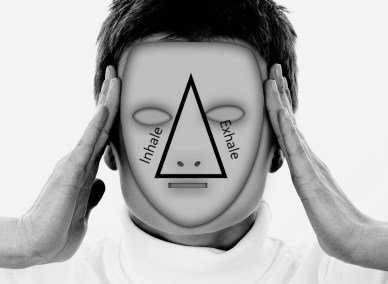
One technique I like to use is the ‘balancing triangle breath’.

This may sound strange, but in my mind’s eye I draw a triangle with my breath between my nose and third eye.

If you want to try it: Inhale through your left nostril (you can block the opposite nostril with thumb), taking the breath up to the third eye (centre of forehead), then on the exhale see your breath travel from the third eye down the right nostril and then back over to the left nostril. After a few breaths reverse the flow from right to left, and then keep alternating.

The image may help you get a better idea of what I mean (I apologize for the creepy face).

The above technique not only helps you unplug and re-centre, it also helps balance your masculine and feminine energy (learn more here).

Take a Salted-Magnesium-Essential-Oil Bath:

A salt bath with added magnesium and lavender is an incredible combination for instilling calm and balance. It’s also super soothing to your emotions and helps you unplug from the world.

Salt is great for clearing all types of people energy, especially when it is negative. It also heals and softens the skin.

Magnesium helps one relax, and boosts energy, supports the endocrine system and aids sleep (quality sleep is essential for repairs). You can buy magnesium bath salts in most supermarkets.

An essential oil, such as lavender, is both relaxing and uplifting and is great to use after being peopled.

Add a grounding crystal into the mix and you have a super-powerful formula for unplugging. Find out the best grounding stone for an Empath here.

Avoid Negative People

This is something I probably don’t need to remind you of, but I also know how hard it is to do. If there’s one thing that can suck dry your last remnants of goodwill, it is being around negative people or ‘energy vampires’

Did you know, science has acknowledged that by just spending too much time around negative people it can influence your health and happiness?

There are many studies showing how prolonged ‘people stress’ can alter gene expression within the immune system… Meaning: anyone can become sick just by hanging out with negative people. For an Empath, however, who can wear another person’s emotional energy like a heavy winter coat, it tends to have a double impact!

So, if you find you are affected by being around negative people, the above are some simple but effective ways to unplug from their energy.

If you have any other techniques that work for you, feel free to share in the comments below

Hope this helps.

Until next time.

Stay empowered.

Diane.

©Diane Kathrine

Why Are So Many Empaths Awakening Now?

Have you noticed more and more people are discovering they are Empaths?

Have you ever wondered why?

It cannot be denied, there is a wave of Empaths who have awakened to who they are in recent years.

More and more are coming to understand that many of the challenges, they have faced throughout life, have come about because they are an Empath.

Why is this awakening happening now?

Good question. There has to be a reason. Right? Continue reading →

Whose Emotion Are You In? A Guide For Empaths


Is this your emotion you are feeling? Or does it belong to someone else?

Learning to differentiate between ‘whose emotion belongs to whom’ certainly proves to be a challenge for many Empaths.

Not recognizing other people’s energy, within oneself, is a common theme within the Empath world. Just knowing you take on the emotions from others, does not mean you can automatically discern them from your own or are able to prevent them from affecting you. Continue reading →

Why Are Empaths So Easily Hurt By Criticism?


There is no escaping this simple fact of life, the majority of Empaths are easily hurt by the criticisms and judgements of others. In some cases, so much so, that it may prevent them from taking any creative risks in life.

The fear of criticism holds too many good Empath’s back.

But as the old saying goes:

‘The only way to avoid criticism is to say nothing, do nothing and be nothing’.

And I doubt there are many Empaths who want to go through life doing nothing. Continue reading →

How Do You Know If You’re An Introvert Empath?


How would you describe yourself, introvert or extrovert?

Many Empaths identify with being an introvert, for the reason that introversion tends to go hand-in-hand with an Empath’s journey. But that’s not to say there are no extrovert Empaths.

If you started life exhibiting more extrovert ways, the way the world makes you ‘feel’ can trigger or build introvert leanings, such as: a regular need for solitude, not enjoying spending time around people, experiencing social aggravation when around crowds, etc. Continue reading →

How do You Know if You are an Empath or Simply Sensitive?

Do you ever wonder whether you are an Empath or not?

Over the years, I have often been asked the question: ‘How do I know for sure if I’m an Empath?’

My answer always tends to be the same: Generally, if you’re an Empath when you discover the term and the traits it encompasses, you just know whether it applies to you or not. It is like a light bulb moment. You finally have an explanation for all that you feel and have experienced throughout your life… But, there are always exceptions. Continue reading →

Uncovering Power Imbalances Within The Empath

Today, I want to address the subject of power imbalances within an Empath and the need to control what we feel.

As Empaths, many of our emotional sensations are amplified. We react to criticism much more than most and, when out of balance, we become incredibly oversensitive to everyday life situations.

Because of this, we may suffer with depression and are more open to attract depressive moods from others (like attracts like).

In my post: Why do Empaths have Such a Strong Sense of Belonging, I made reference to Empaths knowing when something is wrong in their surroundings, even if they don’t know exactly what it is.

The fact that so few people have control over their lives makes for a lot of unhappy people. Empaths pick up on the collective sense of dissatisfaction, whether they are aware of it or not, which can greatly affect their own moods. This can then trap them in negative thinking patterns.

As Empaths, we get down when it seems like we have no control of the way we feel. Which is understandable. Getting bombarded with the emotional energy of others (on top of our own emotions) is no fun, and it can certainly influence the way we operate.

What we pick up from others can shape our life, especially when we are not aware the emotional energy we are experiencing does not belong to us. (If you struggle with defining the emotional energy of others read this.)

But other people’s energy is not the only thing that can lead to emotional instability and a sense of power imbalance. Continue reading →